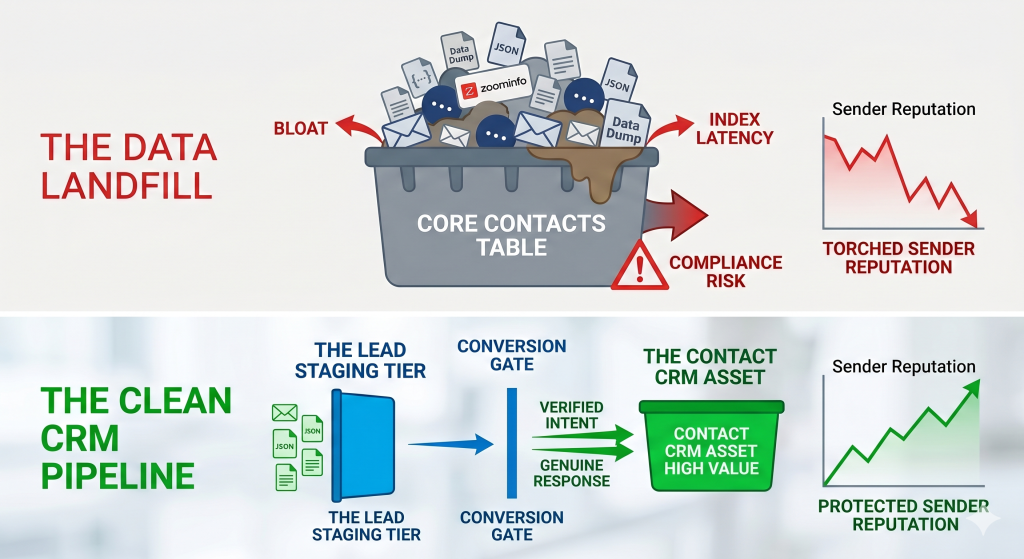
Most enterprise organizations are unknowingly sabotaging their own revenue engines through a single structural mistake.
They are dumping millions of rows from third party data providers and cold marketing lists straight into their core Contacts table.
Salesforce actually solved this architectural problem 20 years ago. Most enterprise teams just completely forgot the context.
The Invisible Operational Tax on Enterprise CRM Data Architecture:
• It creates severe database index bloat.
• It slows down critical hot-path queries for the sales team.
• It sets up a catastrophic compliance and governance footgun.
If a marketing team misses a single global scope filter in a mass broadcast, the system accidentally emails a million cold leads. That triggers instant legal exposure and torches an enterprise sender reputation that takes months and millions of dollars to rewarm.
The original CRM architecture separated these records for a strict operational reason.
Salesforce Leads vs Contacts: A Lead is Unearned Data
It is a cold purchased list, a scrape from a third party website, or a bulk dump from ZoomInfo that has basic intent signals but zero relationship with the brand. It is high volume, low trust, and completely disposable. It belongs in a skinny, isolated staging layer where it can be heavily throttled and easily pruned.
What is a Contact? An Earned Enterprise Relationship Asset
There is validated intent and a real human response, whether that specific enterprise deal closes or not. They are not a customer yet, but they have earned their way into the core CRM pipeline.
Summary Matrix: Salesforce Leads vs Contacts Best Practices
| Metric | The Lead Staging Tier | The Contact CRM Asset |
|---|---|---|
| Data Trust | High volume, low trust, disposable | Lower volume, high trust, heavily protected |
| Data Schema | Skinny payload (Email, basic intent JSON) | Rich profile (Custom fields, active lifecycle) |
| Send Strategy | Throttled, isolated outbound stream | Normal, highly engaged delivery stream |
| Retention | Easily droppable / partitionable | Permanent relationship asset |
The costliest mistake enterprise companies make is inversing this focus.
Organizations spend fortunes mapping complex attribution, deep lifecycle tracking, and endless custom fields onto cold Leads that will likely never reply.
Meanwhile, they treat Contacts like they are already won customers.
The CRM Lead Conversion Step is an Architectural Gate
It is a high stakes mechanism designed to protect data integrity, marketing attribution accuracy, and domain deliverability.
When an enterprise CRM begins to feel like a landfill instead of a garden, the solution isn’t more data cleaning tools. The solution is fixing the structural bottleneck at the gate.