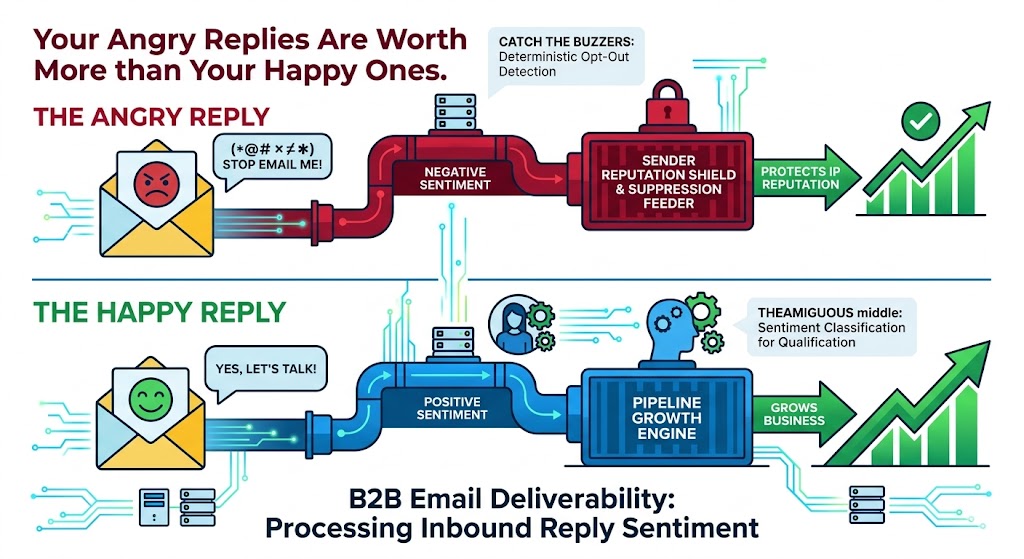
While mapping out inbound email processing architectures for enterprise outreach engines, a massive infrastructure reality becomes clear.
Your angry replies are worth more than your happy ones.
When organizations build or configure sales automation, the natural instinct is to optimize exclusively for positive responses. The “yes, let’s talk” is what everyone metrics. But from a pure infrastructure and deliverability standpoint, the negative responses are what protect the business from disaster.
Why Outbound Email Automation Fails at Scale:
• A reply is just an envelope. What is inside decides everything.
• Most standard marketing automation platforms just flag a generic “replied” status and halt the sequence.
• If a recipient writes back with “stop emailing me” or “where did you get my data,” that is a high priority system buzzer.
If your data engine does not catch that specific negative sentiment in seconds, the recipient hits the spam button. At enterprise scale, those automated spikes cook your IP reputation. Suddenly, your high-value transactional emails stop hitting the inbox.
The positive reply grows the pipeline. The negative reply protects the core asset.
Architecting B2B Email Deliverability Protection
1. Deterministic Rule Matching
Explicit opt-outs, legal phrases, and spam threats must be caught instantly using deterministic string routing and header parsing. These clear cases should never be left to interpretation.
2. Natural Language Sentiment Classification
The ambiguous middle ground (soft nos versus actual interest) requires lightweight AI classification layers. This prevents operational errors, like treating an out-of-office auto-reply as a valid human conversion signal.
To protect enterprise sender domains, negative sentiment must be treated as a first class suppression feeder sitting directly adjacent to hard bounces and complaints.
When uncertainty occurs, data systems should bias heavily toward safety. A false positive opt-out costs a single unverified lead. A false negative costs a blacklisted domain.
Inbound Sentiment Analysis is a Core Security Guardrail
Building an automatic sentiment processing gate into the architecture is the only way to safeguard scaling outreach platforms.
If your automated outbound workflows lack automated inbound classification, you are handing your growth teams a flamethrower without a safety switch.